
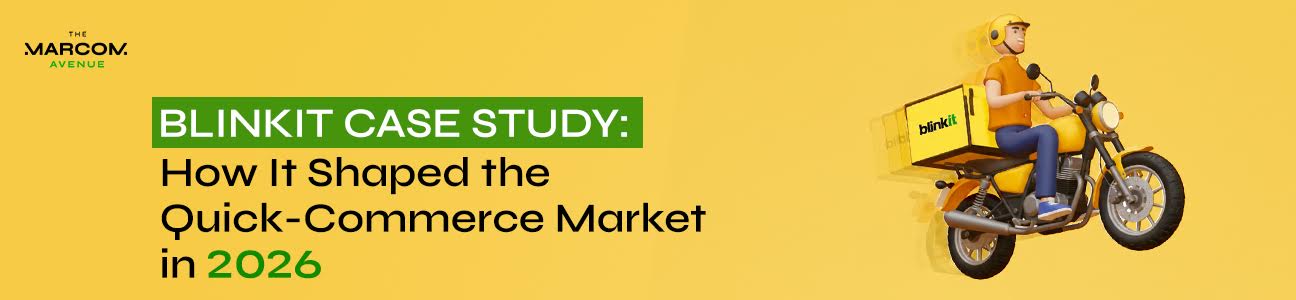
The retail landscape in India has undergone a fundamental structural change over the last few years. What was once a convenience-driven experiment has evolved into a primary procurement method for urban households. This Blinkit case study analyses the operational shift from traditional e-commerce to the instant model that now dominates the market. By early 2026, Blinkit has shed its "experimental" label to become a reliable, high-frequency utility for the average Indian household.
Cracking the future of quick commerce in India means looking under the hood of a Blinkit growth strategy that finally balanced the scales—stabilising unit economics without sacrificing those sub-10-minute delivery speeds.
If you ask how Blinkit became successful, the answer is aggressive decentralisation. They stopped functioning as a traditional warehouse entity and started acting as a digital neighbourhood store. By 2026, speed has stopped being a "luxury" and has become a baseline requirement for the urban Indian shopper. After hitting the 1,500 dark store mark in mid-2025, Blinkit’s footprint aggressively scaled toward 2,000 by the start of 2026.
The mechanics of this Blinkit case study in India aren't just about fast bikes; they rest on a fundamental structural shift:
Micro-Warehousing at Scale: By squeezing dark stores into a 2-kilometre radius of residential hubs, Blinkit effectively eliminated the "last mile" bottleneck. In dense zones like Gurgaon or Bangalore, this is what makes a 9-minute "click-to-door" cycle physically possible.

For any brand trying to break into this space, being "online" is no longer enough. You must be discoverable at the exact second a need hits. This is why the best SEO company in India is now a vital partner; you have to own the search intent before a user even opens the app. This mirrors the growth trajectory of other giants, such as how Big Basket became a preferred choice for grocery shoppers by obsessing over stock reliability and user trust.
A major turning point in the Blinkit business model occurred in late 2025. Moving away from a pure marketplace commission model, Blinkit shifted to an inventory-led (first-party) model. By Q3 FY26, nearly 90% of the Net Order Value (NOV) came from Blinkit’s own inventory.
This shift was a masterstroke for profitability. By purchasing, owning, and selling inventory directly, the platform captures the full product margin rather than just a 15-20% commission. This 1P shift contributed over half of the 1-percentage-point EBITDA improvement seen in early 2026. For investors, this transformed the "cash burn" narrative into one of "retailer margins."

Earlier, quick commerce was a war of burning cash through discounts. The Blinkit marketing strategy in 2026 has moved toward building a habit-loop. They have moved from being the "cheapest" to the most "dependable." Their communication focuses on the "cost of time" rather than price tags.
As quick commerce in India matures, the competition is about precision. This is where an artificial intelligence optimisation company becomes a critical partner. Brands now use AI to predict depletion cycles—if you bought milk on Monday, the app knows you’re likely out by Thursday. By using predictive push notifications, Blinkit ensures it is the first solution a user sees.
Your content has to work just as hard. To stay relevant in 2026, brands must ensure their content marketing strategy is future-proof by prioritising data-backed utility over theoretical claims.

The future of quick commerce in India is no longer restricted to the kitchen. The Blinkit business model has effectively swallowed portions of the electronics, beauty, and fashion industries. During the 2026 Republic Day sales, the Beauty and Personal Care (BPC) category saw a 75% surge in order volume on quick commerce platforms.
Instant Electronics: Need a MacBook charger or a PlayStation controller for a late-night session? It arrives in 12 minutes.
The Beauty Surge: Platforms like Zepto and Blinkit are now the primary discovery channel for D2C beauty brands.
Impulse Fashion: Rapid delivery of apparel for "emergency" fashion needs—like a white shirt for a last-minute interview.
|
Metric |
2024 Average |
2026 Realities |
|
Delivery Speed |
13 Minutes |
8.5 Minutes |
|
Average Order Value (AOV) |
₹450 |
₹820+ |
|
Product Range |
10,000 SKUs |
30,000+ SKUs |
|
Dark Store Count |
~500 |
2,000+ |
In 2026, market dominance isn’t just about the stopwatch; it’s about the seat a brand has secured at the household dinner table. Blinkit’s integration into the Eternal Ltd (formerly Zomato) ecosystem has built a competitive moat that most rivals find nearly impossible to cross.
Imagine you’ve just ordered dinner on Zomato, and a perfectly timed prompt suggests grabbing a cold beverage or a quick dessert from Blinkit. This isn't just a simple cross-sell—it is a calculated play to weave the brand into your daily routine, driving up Customer Lifetime Value (CLV) by becoming an effortless, recurring habit.
Managing a narrative this complex is where the pressure hits for any PR agency in India. Now that Blinkit is a staple in Indian homes, "good enough" communication doesn't cut it—the focus has shifted to radical transparency.
This means moving beyond PR fluff and being direct about things like delivery partner welfare, transparent pay scales, and the actual progress of their all-electric fleet. Market leaders have stopped chasing hollow media hits. Instead, the focus is now on building a 360-degree PR strategy that earns genuine, long-term authority in a market that can see through anything else.
The Blinkit growth strategy isn't without hurdles. While metros provide the density needed for 9-minute deliveries, expanding into Tier-2 and Tier-3 cities presents a "density problem." Lower order volumes per square kilometre make the dark store model harder to sustain.
Additionally, moving into electronics and fashion introduces the "returns complexity." Groceries don't get returned because they don't fit; a pair of sneakers might. Mastering the "Reverse Logistics" of quick commerce is the final frontier for platforms in 2026.
The Blinkit case study proves that when you align logistics with human psychology, you don't just find a market—you change how people live. Quick commerce has moved from a luxury to a vital part of the urban Indian infrastructure.
If your brand wants to survive this transition, a generic digital plan won't cut it. Whether you need the best SEO company in India to capture high-intent searches or the best digital marketing services in India to scale your growth, The Marcom Avenue has the technical depth to make it happen.
Zomato Investor Relations (Blinkit Financials): Zomato FY25-26 Shareholders' Reports – Primary source for dark store scaling (2,000+ units), the 1P inventory pivot, and EBITDA margin improvements.
RedSeer Strategy Consultants: Quick Commerce Sector Analysis 2026 – Market data regarding the $5.5 Billion valuation of the Indian Q-Commerce industry and consumer SKU adoption rates.
Ministry of Commerce & Industry (Invest India): Retail & E-commerce Hub – Reference for regulatory shifts and the digital infrastructure supporting rapid delivery networks in Tier 1 cities.
Economic Times/Retail: Blinkit Expansion & Category Growth – Secondary source for the 75% surge in Beauty and Personal Care (BPC) volumes during 2026 festive sales.




With over 6 years of expertise in crafting digital strategies in SEO industry, I head the SEO team at The Marcom Avenue, driven by innovation and data-backed decisions. I’m dedicated to sharing valuable insights and emerging trends to empower marketers. Together, let's unlock the true potential of digital marketing!


 What Is URL Structure in SEO? Best Practices and Impact on Rankings
 How McDonald's Used Hyperlocal Advertising to Drive Store Visits: A 2026 Case Study
 SEO for Shopify: The Ultimate Guide to Higher Rankings