
The consumer technology landscape during the early 2020s was effectively a graveyard of creativity. Innovation had plateaued into a dull cycle of "boring" glass slabs, with titans like Apple and Samsung settling into a predictable, safe duopoly.
In this climate, the emergence of Nothing felt less like a standard startup debut and more like a tactical intervention. Led by OnePlus renegade Carl Pei, the brand asked a simple, piercing question: Why has technology lost its soul?

This Nothing brand case study isn’t just a tally of units sold. It serves as a strategic roadmap for how a challenger managed to:
Ship over 10 million products globally by early 2024, as reported in official shipping milestones.
Achieve a $1.3 billion valuation (Series C) following a $200 million funding round led by Tiger Global.
Cement India as its global manufacturing heart, backed by a massive $125 million joint venture with Optiemus Electronics.
Pioneer AI-native hardware that finally moves beyond the traditional, clunky "grid of apps."
Nothing proved that in a world of predictable, machine-made sameness, people actually hunger for something a bit more "raw." It’s visible in everything they do. From that gutsy transparent aesthetic to the high-stakes gamble of binning a 2026 flagship launch just to get the software right, every move feels less like a corporate mandate and more like a deliberate push toward a tech world that actually feels human.
The Nothing company marketing strategy was built on the diagnosis that modern tech had become opaque—both literally and metaphorically. Nothing didn’t just add features; they stripped the paint off. They leaned into a "retro-futurist" vibe that basically put the raw engineering on display, turning the phone's internals into the main attraction.
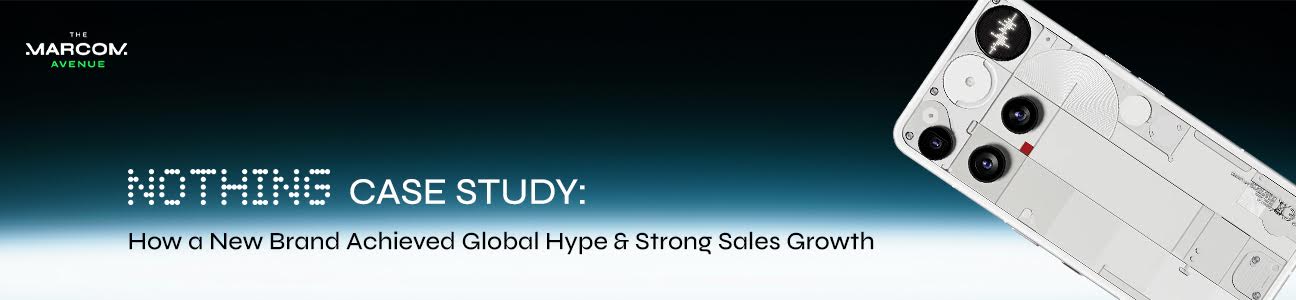
The Glyph Interface is the undisputed crown jewel of the Nothing phone marketing strategy. It isn't just a gimmick; it is a tool for "intentionality":
The Glyph Matrix (2025): The new setup is a total gear shift, using a pixel-heavy display that actually lets you scroll text or waste time on built-in mini-games.
Screen-Free Interaction: It’s all about getting you off the screen. By using distinct light cues for alerts, it nudges you to keep the phone face down, cutting out that mindless habit of constant scrolling just because a notification popped up.
This level of visual "hook" is exactly what modern brands need to stop the scroll on social media. For any business, achieving this level of distinctiveness is the primary goal when seeking the best digital marketing services in India.
Hype is often cheap, but execution is where the real cost lies. How did the Nothing brand become successful? Instead of splashing cash on high-stakes Super Bowl slots, they turned their product reveals into cinematic events through a "surgical leak" strategy. By drip-feeding breadcrumbs to journalists and the tech-obsessed, they essentially hijacked the news cycle for months—all without burning a hole in their marketing budget.
|
Timeline |
Milestone |
Strategic Driver |
|
2022 |
Phone (1) Debut |
Viral "invite-only" drops created an immediate cult-like demand. |
|
2024 |
10M+ Units Shipped |
Mass-market scaling via the budget-friendly Phone (2a). |
|
2025 |
Unicorn Status |
$200M Series C funding; $1.3B valuation reached. |
|
2026 |
The Strategy Shift |
Flagship (4) skipped to prioritise meaningful experience over cycles. |
Ditching the 2026 flagship was a bold, high-stakes play by Carl Pei that caught the industry off guard. Following the blowback over the Phone (3)’s steep ₹80,000 price tag, the brand returned to its core identity by dropping the Nothing 4a series on March 5, 2026.
This move was a brilliant "course correction" that balanced premium aspirations with the reality of value-conscious markets. To understand how to craft this kind of narrative, exploring how to transform brand identity through the impact of storytelling is essential.
The marketing strategy of the Nothing brand involves high-level digital execution, moving with the precision of the best SEO company in India.
Keyword Targeting: They own specific niches like "minimalist Android" and "bloatware-free OS" rather than fighting over broad, expensive terms.
Authentic Advocacy: Carl Pei acts as the brand’s chief influencer. His YouTube videos build a level of trust that traditional corporate ads simply cannot buy.
Community Investment: They managed to pull in over $16M through community crowdfunding to date. This wasn't just about the cash; it was about making sure their core users actually felt like owners.
This strategy has resulted in social engagement rates nearly 4x the industry average. For brands in the region, a PR agency in India can help replicate this kind of raw, founder-led narrative.
Nothing doesn't just sell to its fans; it builds with them. The Nothing company’s marketing strategy is rooted in "Community Co-Creation"—from voting on hardware colours to the 2025 "Community Edition" project, where fans designed the glow-in-the-dark hardware for the Phone (3a).
In early 2026, Nothing registered CMF India Private Limited as an independent subsidiary. With a $125 million manufacturing joint venture with Optiemus Infracom, India is now their global R&D and production hub.
This move signals a pivot from mere "assembly" to deep-rooted local innovation. By establishing a permanent legal and governance home in Gurugram, Nothing is leveraging India’s engineering talent to design products intended for global export.
Looking ahead, Nothing is moving toward an AI-native world. Nothing OS 4.0 (based on Android 16) has introduced features that move beyond the static, old-fashioned app grid:
AI Dashboard: Provides transparent insights into how on-device language models are actually being used.
Essential Space: An AI tool that automatically organises galleries and summarises meeting transcripts in seconds.
Vibe Coding: A revolutionary feature allowing users to build their own mini-apps through simple, conversational text prompts.
This rapid pivot is why they are a case study in success for anyone looking to break the scroll trap and escape the AI-led sea of sameness.
They don't hide behind corporate walls; instead, they post raw factory footage and speak candidly about supply chain headaches. This kind of "no-filter" transparency has earned them massive respect from GenZ.
Back in 2025, they even took to social media to own up to the Phone (3) pricing situation, admitting they owed it to their early adopters to do a better job at shielding them from sudden price cuts. This is a tactic an AIO company would recommend to ensure your content feels human, not robotic.
Nothing’s rise is essentially a loud wake-up call for an industry currently choking on its own "safe" algorithms. It shows that people are actually starving for brands with some real backbone. If you're aiming to catch that same spark in 2026, you’ve got to burn the old corporate playbook.
Stop eyeing people as "target demographics" or just another row in a database. You have to pivot—bring them into the messy part of the creative process and give them a reason to feel some genuine skin in the game. Raw, unfiltered honesty builds a type of "ride-or-die" loyalty that a billion-dollar ad budget simply can't buy.

At The Marcom Avenue, we believe every brand has a unique story waiting to be told with this kind of precision and heart. Whether you are looking for a PR agency in India to manage your next launch or require specialised SEO Services in India to dominate the digital conversation, our team is equipped to help you scale.
As a leading brand collaboration agency and artificial intelligence optimisation company, we focus on data-driven growth. If you want the best digital marketing services in India, we are here to help you build your own global hype story. The future isn't built by following the crowd—it's built by those brave enough to start with Nothing.




I have more than 5 years of experience in digital strategy and content creation, I lead the Search Marketing team at The Marcom Avenue. I am passionate about innovation and data-driven decisions, I’m committed to providing valuable insights and highlighting emerging trends to empower marketers. Let’s work together to unlock the full potential of search marketing!


 What Is URL Structure in SEO? Best Practices and Impact on Rankings
 How McDonald's Used Hyperlocal Advertising to Drive Store Visits: A 2026 Case Study
 SEO for Shopify: The Ultimate Guide to Higher Rankings