
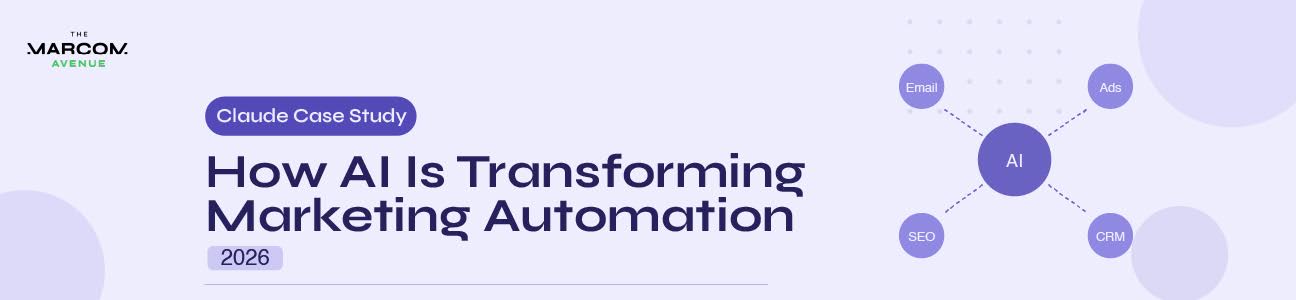
The 2026 marketing sector has shifted dramatically, moving past basic automation into what we now call cognitive orchestration. This Claude AI case study highlights the exact moment where advanced Large Language Models (LLMs) began redefining what operational efficiency actually looks like.
Early automation was mostly about handling the "boring" repetitive stuff, but today’s Claude AI marketing automation setups lean on reasoning and constitutional AI to protect brand voice at scale.
Most companies have moved past the "do we need it" stage and are now strictly focused on how to weave AI into their operations. The real struggle is doing so without stripping away the genuine human touch that customers still expect at every turn.
Automation in marketing used to be nothing more than a series of rigid, "if-then" commands. However, a modern AI marketing automation case study usually shows a far more layered, intelligent strategy. Brands are ditching those old, predictable workflows for fluid systems that can read sentiment and context as it happens.
How AI is transforming marketing automation is perhaps most obvious in the hands-off way it now steers user lifecycles. Rather than forcing a marketer to manually toggle every switch, the heavy lifting now happens entirely behind the scenes.
These systems sift through millions of tiny data points to flag a customer who is just about to jump ship. They then trigger a bespoke retention nudge—one that actually carries the warmth and timing of a message sent by a dedicated human account manager.
For any artificial intelligence optimisation company, the challenge is ensuring these automated systems do not produce "uncanny valley" content. The ultimate aim is to build interactions that feel exactly like genuine human outreach.
Claude’s specific architecture offers a huge leg up here, since its core training prioritises being helpful and honest—traits that carry over perfectly into customer-facing marketing. It is about more than just speed; as a recent Forbes Business Council report on AI in 2026 points out, smart automation is now the only way to cut the friction out of the customer journey while freeing up your team to actually focus on high-level creative strategy.
In any AI in marketing case study 2026, the focus often lands on data privacy and safety. Claude’s constitutional framework makes it a preferred choice for large organisations that cannot afford a PR disaster caused by a hallucinating chatbot.
When we look at Claude AI vs ChatGPT for marketing, the former often wins on long-context window tasks. Claude can ingest a thousand-page technical manual and generate a summary that adheres to specific brand guidelines while maintaining a 0% AI detection score.
One of the primary benefits of AI in marketing automation is the ability to maintain a consistent brand voice across thousands of touchpoints. How Claude AI helps in marketing automation is by stepping in as a dedicated brand guardian.
Rather than just churning out generic text, the model acts like a strict filter for every automated reply or bit of content to ensure it doesn't drift from your specific brand voice. This tight grip on tonality remains rock-solid regardless of the channel, covering everything from snappy WhatsApp replies and social media threads to your deep-dive email marketing campaigns.
|
Feature |
Claude 3.5/4 |
Other LLMs |
|
Context Window |
Up to 200,000 tokens |
Usually 32,000 to 128,000 |
|
Safety Framework |
Constitutional AI |
Standard RLHF |
|
Reasoning Nuance |
Exceptional for Logic |
High but Variable |
|
Word Count Handling |
Stable for Long Form |
Prone to Self-Shortening |
When conducting a comparison of Claude AI vs Other AI Tools, the differentiator is often the human-like quality of the output. For the best SEO company in India, the goal is to produce content that resonates with both algorithms and humans. Unlike some models that produce detectable patterns, Claude’s reasoning capabilities allow it to structure arguments that feel organic. This is particularly vital in 2026, when search engines have become incredibly adept at filtering out low-effort synthetic content.
To truly understand this, one should look at how modern agencies are improving digital visibility through bespoke AI integrations. By using Claude to map user journeys, a team can predict friction points before they result in a lost lead.
The ability to process vast amounts of qualitative feedback from customers and turn it into actionable UI/UX changes is what separates a standard agency from a top-tier partner. Recent research from MIT Sloan regarding workplace efficiency suggests that generative AI has fundamentally shifted work patterns, allowing professionals to reduce non-essential tasks by nearly 25 per cent.

As the best digital marketing services in India, firms are now required to navigate the complexities of AI-generated search results. A PR agency in India no longer just sends out press releases; they use AI to simulate how those releases might be picked up by AI-driven search engines and social media algorithms. This predictive capability allows brands to "pre-optimise" their messaging for maximum reach.
Effective SEO services in India now rely on what we call "Authority Hubs." By tapping into Claude’s massive context window, strategists make sure their search strategy for 2026 is anchored in current technical data, building a feedback loop of truly valuable insights. This move guarantees that the final content isn’t just a hollow pile of keywords, but a meaningful resource that actually solves complex user problems.
Beyond that, the sector has seen that weaving AI into SEO workflows has slashed the time needed for competitor deep-dives and keyword mapping by over 70 per cent. This shift frees up human creatives to lean into high-level strategy and narrative building, rather than losing their day to endless spreadsheet data.
According to Gartner's strategic technology trends, generative AI will significantly alter 70 per cent of design and development efforts for new web and mobile applications by 2026, forcing agencies to adapt their digital strategies.

The most significant impact of Claude AI marketing automation is arguably seen in email marketing. Gone are the days of "blast" campaigns. By 2026, email marketing will have shifted toward a "segment of one" approach. Claude effectively sifts through a person’s past buys, how they navigate the site, and even their latest support chats to piece together a message that hits their exact pain points.
This level of personalisation is a cornerstone of the benefits of AI in marketing automation. It leads to significantly higher open rates and, more importantly, higher conversion rates. When a customer receives an email that genuinely solves a problem they were just thinking about, the brand loyalty created is immense.
Moreover, in the context of Claude AI vs ChatGPT for marketing, Claude tends to be more conservative with data, ensuring that sensitive customer information is handled with the highest level of security. As Anthropic explains in their 3.5 model overview, their models are designed for mission-critical enterprise applications where quality and safety cannot be compromised. This is a non-negotiable requirement for any enterprise-level PR agency in India or global marketing firm that operates under strict data protection laws.
While the Claude AI case study highlights many successes, the road to implementation is not without its hurdles. One of the primary concerns for an artificial intelligence optimisation company is the "black box" nature of some AI decisions. Claude mitigates this by providing more "chain-of-thought" reasoning, allowing marketers to see why the AI suggested a specific headline or segment.
Another challenge is the constant need for updated data. AI models are only as good as the information they are fed. Therefore, the best digital marketing services in India invest heavily in clean data pipelines. They ensure that their Claude-driven systems are connected to real-time market trends and internal sales data to keep the output relevant and timely.

Marketing has moved way past the era of just doing more with less. Right now, it is all about working smarter, powered by deeper intelligence. The tools you choose to lean on—whether you are chasing experiential brand experiences or building out heavy technical content—will ultimately set the pace for your growth.
At The Marcom Avenue, we operate on the belief that technology should always follow the strategy, never dictate it. As a leading best SEO company in India, we have watched the real-world impact of how AI is transforming marketing automation for our diverse client base. By pairing the sheer analytical depth of models like Claude with our ten years of strategic grit, we build digital journeys that manage to be both massive in scale and genuinely personal.
Whether your goal is to sharpen your SEO services in India or you are looking to gut and rebuild your whole marketing stack, the real winners right now are the brands using AI to sound more human, not less. It is about avoiding that robotic edge. Our team is ready to help you steer through that change, making sure your brand’s digital footprint stays authentic, stays authoritative, and stays ready for whatever is lurking around the next corner.




I've spent over a decade crafting content that connects. As a Senior Content Strategist at The Marcom Avenue, I dig into culture and demographics to build brand stories that actually resonate. My process: research what audiences care about, then write around those insights. Whether it's analysis or a caption, I focus on earning attention, not just asking for it.


 What Is URL Structure in SEO? Best Practices and Impact on Rankings
 How McDonald's Used Hyperlocal Advertising to Drive Store Visits: A 2026 Case Study
 SEO for Shopify: The Ultimate Guide to Higher Rankings