
Let us be honest, we judge digital interfaces in a heartbeat. Usually, it happens faster than we would ever want to admit. Most people do not sit down to read your site like a novel. They scan.They hover. They hesitate. Maybe they tap a button once or twice. In those few seconds, they have already decided: is this site worth the effort, or is it just a headache?
When a visitor bounces, it is rarely because your product is inherently bad. More often, it is because the experience felt heavy for no obvious reason. This is exactly where the difference between UI and UX design stops being a textbook term and starts being a business reality.
Confuse these two, and you’ll likely build a site that looks great in a portfolio but leaves users stuck in a dead end. To bridge the gap between "impressive" and "effective," we have to look past the surface and focus on the friction points in a customer’s journey.
In an era where switching costs are basically zero, getting the UI/UX balance right is the only thing standing between a high conversion rate and a wasted marketing budget.
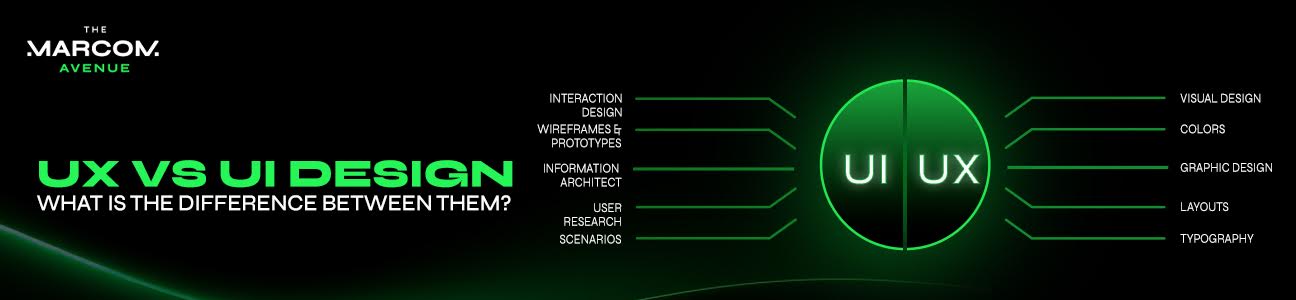
It’s easy to see why people mix them up, but they’re solving fundamentally different problems. Look at it this way: UX is the logic behind the layout—it’s the reason a "Buy" button is where your thumb expects it to be and why you don't get lost in a sea of menus. UI is what makes that experience feel premium.
Think of it as the "personality" behind a bold font or how a link changes colour the second you hover. It tells people the site actually functions. A menu can be flawless from a coding standpoint, but looking like a 2010-era relic kills your credibility instantly. You can’t expect people to stick around and test the functionality if the initial "vibe" feels like a DIY amateur job.
|
Feature |
UX Design (User Experience) |
UI Design (User Interface) |
|
The Goal |
Logic, flow, and getting things done. |
Aesthetics, mood, and visual delight. |
|
Focus |
How a user feels and moves. |
How a user sees and interacts. |
|
Core Tasks |
User research, wireframes, and logic. |
Layouts, colours, fonts, and icons. |
|
Success |
High completion rates and zero confusion. |
Brand trust and visual wow factor. |
|
Analogy |
The Engine: It makes the car go. |
The Paint & Dashboard: The look and feel. |
The core UX and UI design distinction is that UX focuses on intent and the underlying purpose of the journey. A real custom web development company maps out how humans behave long before they ever pick a colour palette. The logic is that an interface cannot be beautiful if it is not first functional.
UX is all about cognitive load. Essentially, it is the measurement of how much thinking a person has to do Logic over Looks: Navigation and the order of steps are strictly UX territory. If a user has to think about where to go next, the logic has failed.
The Hesitation Test: If a user pauses to wonder, "Where do I click next?", you have a structural failure. Every second of hesitation is a second where they might choose to leave.
The Goal: The next step should feel like a reflex rather than a conscious decision.
A high-performing UX vs UI design strategy acknowledges that the user’s time is their most valuable asset. Research from Forrester has famously indicated that every $1 invested in UX can result in a return of $100. This is because a seamless experience removes the friction that usually stops a transaction in its tracks.
It is the science of making the digital invisible so the user can focus entirely on their goal.o buy your product or sign up for your service. In the world of web design & development services, UX acts as the blueprint.
Example of UX and UI: Think of a digital map. UX is the complex algorithm finding the shortest, most efficient route based on real-time traffic and road conditions. UI is the high-contrast map interface with readable street names and recognisable icons that make it easy to follow while you are driving at 60 km/h.

UI is what shapes the vibe of a platform. It hits the brain before a user reads a single word of your copy. While UX handles the path, UI handles the pavement. It is the sensory layer of the experience.
Snap Judgments: People judge your company's reliability based on alignment, spacing, and font choice. Within 50 milliseconds, a user has already formed an opinion of your website.
The Risk Flag: A messy or dated layout acts like a red flag to a customer’s gut—it signals a security risk. In the world of custom e-commerce web development, you’re asking people to hand over their credit card and address; they won't do that if the site feels like it’s been abandoned since 2015.
The Translator: UI turns a boring skeleton into a readable, clickable interface. It uses visual cues like shadows to indicate that a button can be pressed or a slider can be moved.
If your site’s layout falls apart on a phone or the buttons are so mashed together that people keep mis-clicking, you’ve basically just told your customer you don't care about their time. That’s an instant bounce.
UI is more than just matching brand colours; it’s making sure the mobile experience doesn't feel like a cheap version of the desktop. You should use scale and contrast to lead the user’s gaze—so the next tap is obvious, and they never have to go searching for it.
UX is not art; it is more like a science. It starts with watching people, tracking data, and fixing friction points. When you look at the difference between UI and UX design, you are looking at the difference between a casual visitor and a converted customer.
Financial Impact: For anyone doing custom e-commerce web development, friction equals lost money. A confusing checkout button or a slow-loading page is a literal leak in your revenue. Statistics show that 88% of online consumers are less likely to return to a site after a bad experience.
The Lighting Effect: UI supports usability. It makes the path clear. You cannot put a pretty UI on a broken UX. That is like painting a car with no engine; it might look great in the driveway, but it will not take you anywhere.
Coordination is Key: This is the level of work you expect from a top website development company in India. Without this coordination, your site is just a collection of pages, not a growth tool for your business.
The UX vs UI design split is actually quite similar to heavy engineering. Take solar EPC projects, for instance. The system design and the technical plan must be perfect before the panels are ever installed.
Tata Power Solar & Adani Solar: These giants focus on the massive back-end engineering, which we can compare to the UX of power. They ensure the energy flow is reliable and the infrastructure is sound.
Spectra Solar Power: They bridge that gap by making the transition from consultation to installation feel human and simple for the end user.
They prove that when the interface is easy, the choice to switch becomes obvious. Top-tier Indian developers always prioritise the core logic before they even touch the CSS. If the basic workflow is broken, you’re just putting lipstick on a pig—no amount of fancy design will stop a project from failing.

Annoyances do not just disappear when a user closes the tab. They build up over time. Eventually, that friction trains your customers to go elsewhere. If you’re hunting for a top developer in India, look at how they handle UX before anything else. It’s the easiest way to tell if you’re hiring a shop that just ships code or a partner that actually cares if your project succeeds.
The First Second: UI wins the initial trust. It is the handshake at the start of a meeting.
The Long Haul: UX ensures you actually keep that trust. It is the substance of the meeting.
Mobile-First: Real web design and development services rethink the structure for the thumb. They do not just shrink the desktop site; they build for the specific environment of the user.
The psychological impact of a good interface is often underrated. A messy or dated layout acts like a red flag to a customer’s gut—it signals a security risk. In the world of custom e-commerce, you’re asking people to hand over their credit card and address; they won't do that if the site feels like it’s not been functional for a long time. The real job of any high-end agency is to strip away that friction so the user never feels like the problem.
The difference between UI and UX design is not about style alone. It is about results. UI handles the look, and UX handles the outcome. In a crowded market, this clarity is your competitive edge.
At The Marcom Avenue, we delve into the structural logic first to ensure your digital assets not only look visually appealing, but also function effectively. As a top website development company in India, we specialise in responsive web design services and custom web development solutions that align with your specific business goals.
Whether you’re scaling an e-commerce store to hit new sales targets or launching a high-performance portal for your corporate team, we don’t just deliver a URL and a design file, but offer comprehensive UI and UX design services to scale up your business through your website. At The Marcom Avenue, we build tools that actually work for your bottom line.
We move past the fluff to create UI & UX solutions for websites that act as growth engines—ensuring your brand doesn’t just exist online but actually leads the conversation. When you partner with us, you’re getting a team that prioritises how your customers actually behave over how they’re "supposed" to think. Every click is an opportunity, and we make sure you don't waste it.




I have more than 5 years of experience in digital strategy and content creation, I lead the Search Marketing team at The Marcom Avenue. I am passionate about innovation and data-driven decisions, I’m committed to providing valuable insights and highlighting emerging trends to empower marketers. Let’s work together to unlock the full potential of search marketing!


 How to Create an Android App Using AI: 7 Simple Steps Explained
 Custom Software vs Off-the-Shelf: Complete Comparison Guide
 Best Language for Website Development in 2026: PHP, Python, Next.js & More