
The modern corporate landscape requires a complete departure from static commercial models. Relying purely on top-of-funnel customer acquisition pipelines is no longer viable in a highly fragmented marketplace. True digital scale requires an architecture built around lifetime value, data iteration, and retention loops.
To build a framework that survives shifting consumer dynamics, organisations must abandon rigid campaigns. Instead, they need an agile approach that merges deep user psychology with advanced engineering analytics. This is where a continuous optimisation engine unlocks sustainable enterprise value.
When mapping out long-term business paths, company leaders frequently ask the question “what is growth marketing and how does it challenge older, classic promotion routines?”
Stripped down to its core, it operates as a granular, metrics-first manual for converting and keeping consumers by refining every individual user contact point, refusing to stop at simple brand discovery. Where historic campaigns obsess over superficial numbers like broad brand exposure and early impressions, an agile setup tracks every stage of consumer interaction.
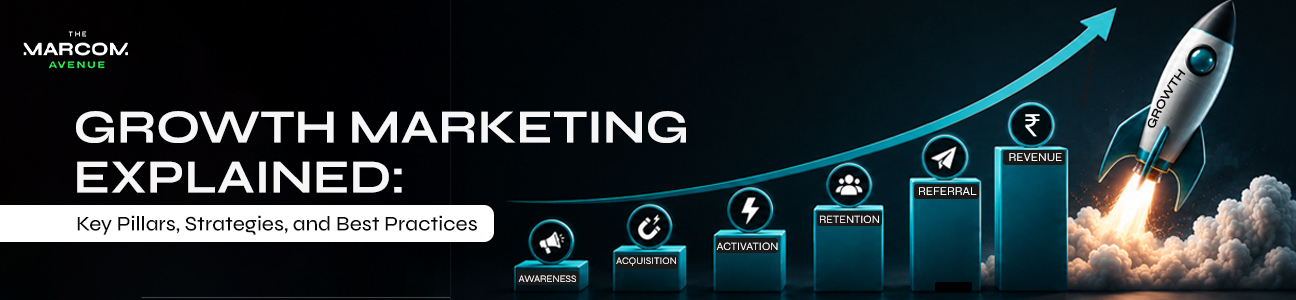
This pathway winds from early brand discovery straight through to deep activation, multi-year retention, organic referral loops, and ongoing revenue extraction. It relies entirely on continuous split testing, iterative copy pivots, and product-driven user flows, a methodology thoroughly dissected in the HubSpot Growth Marketing Strategy Framework.

This structural movement introduces an ongoing debate regarding growth marketing vs traditional marketing models. Traditional structures operate on fixed budgets, creative intuition, and hard launch dates. Conversely, contemporary data-driven architectures rely on flexible resource distribution, continuous multivariable testing, and cross-functional engineering loops. It values real-time behavioural evidence over subjective creative assumptions, transforming your public-facing assets into self-sustaining customer retention engines.
|
Business Model |
Operational Phases |
Transition Point |
|
Traditional Funnel |
Awareness → Acquisition |
Disconnected hand-off to operations |
|
Growth Funnel |
Awareness → Acquisition → Activation Retention → Referral → Revenue |
Continuous lifecycle loop integration |
Before deploying aggressive optimisation blueprints, an enterprise must accurately measure its operating landscape. Scaling without deep numerical boundaries leads to wasted capital and misaligned attribution models.
Market Growth Rate (%) = ((Current Market Size - Previous Market Size) / Previous Market Size) * 100
Masterability of how to calculate market growth gives financial planners the exact mathematical foundation required to allocate assets over multi-year horizons. Finding this percentage means isolating total sales revenue or unit volumes inside an industry branch across a fixed baseline period.
Teams simply deduct last year's total size from current market value, divide that resulting number by the original baseline figure, and multiply the final sum by one hundred. To ground these projections in accepted corporate accounting standards without relying on premium or gatekept materials, analysts frequently consult open-access toolkits like the Wharton-vetted Marketing Metrics Metric Index.
Deploying a high-performance optimisation model requires moving away from isolated ad-hoc tactics. True operational scalability demands a repeatable, cross-functional growth marketing framework that systematically reduces user friction.

|
Phase |
Core Objective |
Primary Action |
|
1. Funnel Diagnostics |
Identify Leakage |
Continuous tracking of user drop-off zones across landing environments |
|
2. Hypothesis Generation |
Prioritise Opportunities |
Deploying ICE models (Impact, Confidence, Ease) to rank testing pipelines |
|
3. Rapid Experimentation |
Validate Variables |
Executing structured split tests to isolate behavioural triggers |
|
4. Analysis & Integration |
Scale Performance |
Documenting outcomes and immediately embedding wins into the core system |
This system functions through a cyclical loop. Each phase builds upon the previous data repository. Documenting failed experiments is treated with the identical value as logging wins, which prevents future resource waste on disproven concepts. Embodying these systematic growth marketing best practices keeps your team focused on highly repeatable, data-backed initiatives rather than short-lived, erratic trends.
Turning abstract frameworks into measurable market traction requires a highly deliberate mix of multi-channel strategies. Businesses must realise that what are growth marketing strategies in practice are interconnected loops that turn user data into compounding commercial outcomes.
True customer acquisition value is fully realised only when early churn is completely eliminated. Optimising your initial user activation sequence through tailored in-app flows and customised text paths ensures customers experience immediate value from your service, lowering churn risks.
Modern discovery platforms rely on complex semantic mapping. Building deep topical authority hubs rather than chasing isolated keywords ensures your domain satisfies strict search engine validation standards, creating sustainable organic loops.
Paid distribution must serve as a data collector rather than an expensive temporary fix. Deploying highly targeted ad structures across primary platforms yields deep behavioural insights that directly inform your underlying product roadmap and organic message strategy.
To evaluate how these strategic pillars balance out against traditional paid acquisition methods, review this baseline metric index:
|
Strategic Focus |
Performance Indicator |
Core Dataset |
Primary Objective |
|
Organic Authority Hubs |
Topical Share of Voice |
Semantic Rank Position |
Sustainable compounding visibility |
|
Retention Loops |
Customer Lifetime Value (LTV) |
Cohort Retention Curves |
Maximising long-term platform yield |
|
Paid Performance Arbitrage |
Customer Acquisition Cost (CAC) |
Real-time Conversion Attributions |
Rapid market testing and scaling |
Navigating these highly advanced customer optimisation architectures requires a deep blend of technical data management and seasoned creative execution. For many modern organisations, building and keeping an internal team of this calibre creates massive operational strain and high overhead costs.
To secure a true competitive edge, brands routinely align with a specialised growth marketing agency or a top-tier performance marketing agency to direct their scaling pipelines. These expert entities provide immediate access to advanced attribution tools, cross-channel data insights, and dedicated infrastructure experts without the long onboarding delays of internal hiring.
Furthermore, integrating these intricate data experiments smoothly into a broader brand strategy requires the guidance of a professional Growth marketing Strategist. These leaders map out your overarching technical layout, aligning your customer acquisition parameters with deep product optimisation blueprints.
When scanning international growth markets, leading enterprises are turning away from transactional suppliers. Instead, they seek long-term collaborative partnership Agencies in India to build resilient digital systems. Working directly with an expert strategic initiatives agency in India ensures that a brand's technical infrastructure, analytical attribution, and local messaging mesh perfectly.
For enterprises prepared to secure dominant market positions, joining forces with the Best Digital Marketing Agency in India provides the technical execution, advanced strategy, and scalable frameworks required to command industry visibility and build compounding long-term authority.
Building sustained digital scale requires a dedicated commitment to continuous analysis, technical agility, and structural optimisation across your entire customer lifecycle. When technical teams bridge the gap between creative execution and deep statistical analysis, a brand transforms its standard web properties into high-yield user retention ecosystems.
Within the fast-moving corporate environment, navigating these sophisticated tech stacks requires a highly structured growth partner. Specialist marketing frameworks like The Marcom Avenue offer the deep technical precision and data-led strategy needed to manage these complex transformations smoothly.
Their cross-functional pods focus on building robust semantic loops, eliminating user drop-off points, and configuring data attribution models that protect margins while expanding market reach.By tying technical analysis directly into long-term business goals, they help platforms remain discoverable, highly authoritative, and naturally resilient against shifting search and discovery algorithms.
Traditional advertising pours its entire budget into early visibility and raw lead generation. Once a customer enters the system, the marketer's job ends. Growth marketing vs traditional marketing frameworks diverge right here: the modern approach owns the full customer lifecycle, using rapid testing to lift activation, retention, referrals, and recurring revenue.
A strategist unifies engineering, product development, and data analysis into an agile execution framework. This alignment ensures that data from performance marketing channels directly informs product features and user onboarding systems.
Modern platforms look past isolated keyword tracking, using advanced semantic modelling to scan for comprehensive answer networks and structured data fields that satisfy exact user intent.




I've spent over a decade crafting content that connects. As a Senior Content Strategist at The Marcom Avenue, I dig into culture and demographics to build brand stories that actually resonate. My process: research what audiences care about, then write around those insights. Whether it's analysis or a caption, I focus on earning attention, not just asking for it.


 Starbucks Rewards Case Study (2026): Gamification Strategies That Increased App Engagement
 How Coca-Cola Uses AI to Personalise Advertising and Improve Customer Engagement
 Duolingo Marketing Strategy: How Social Media Turned a Language App into a Global Brand