
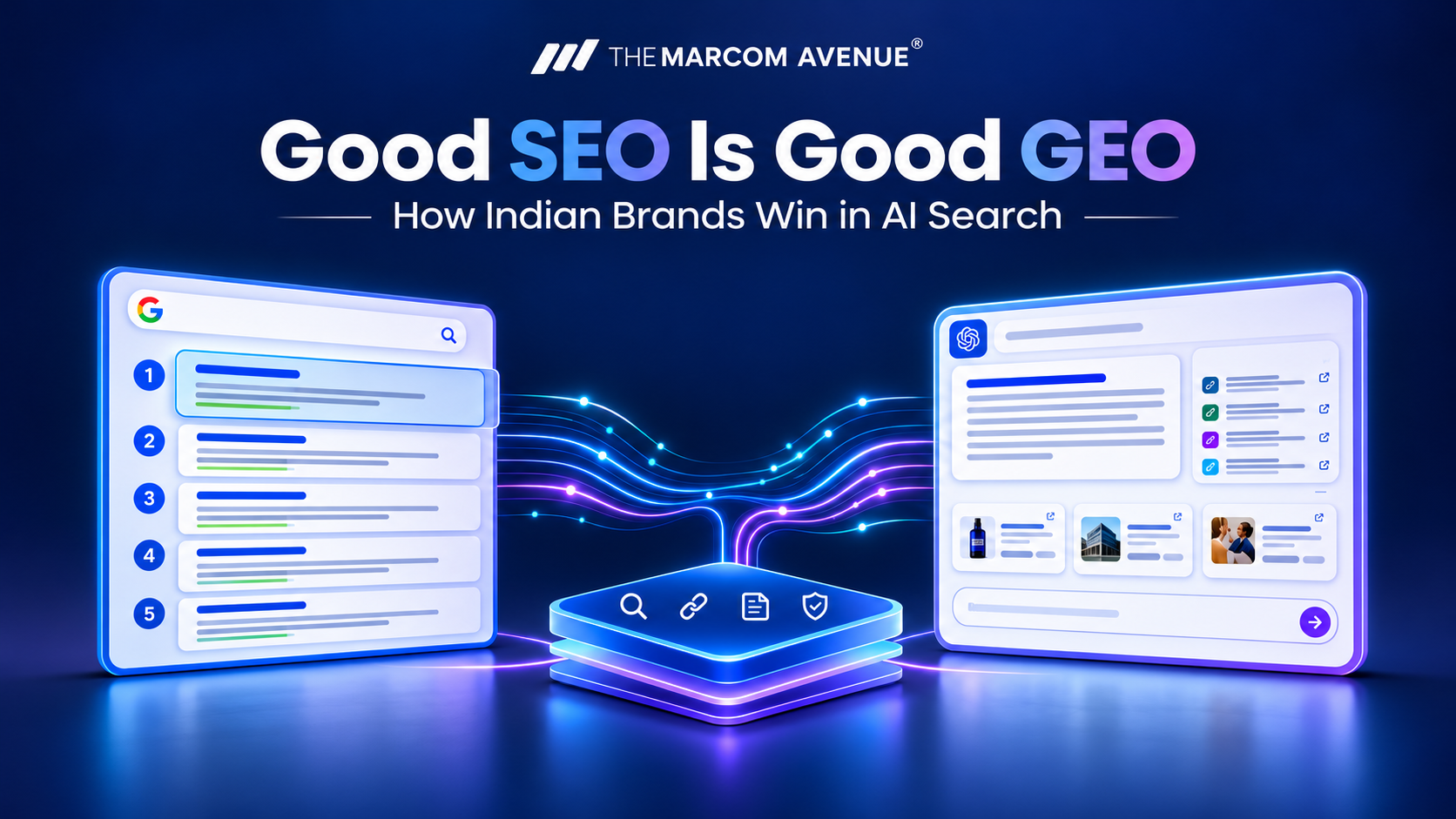
Generative engine optimization is the practice of getting your brand name inside AI-generated answers: the summaries from Google AI Overviews, ChatGPT, Gemini and Perplexity that now sit between your customer and your website. Indian marketers have been selling it as a brand-new discipline with a brand-new price tag. It isn't. Every signal an AI engine uses to decide whom to cite is one that SEO has rewarded for a decade, which is why good SEO is good SEO.
The search results page in India has changed faster than most marketing plans. AI Overviews are live by default for Indian users in English and Hindi, and Google says they lift usage by more than 10% on the query types where they appear. The AI Overviews India SEO impact is already showing up in traffic reports. Marketing heads keep asking us at The Marcom Avenue the same thing: do we need a separate GEO strategy? This guide, part of The Marcom Avenue blog, covers what AI engines reward, how GEO vs SEO really compares, and what to change in your content programme this quarter.
Key takeaways: AI engines pull almost entirely from pages that already rank, so visibility in AI answers starts with the crawlability, authority and content quality that organic rankings demand. The real shift is format. Direct answers, clear structure and earned third-party mentions matter more than before. Brands that shore up their SEO fundamentals and add a GEO layer on top win the blue link and the AI citation. In short, good SEO is good GEO.
But what does GEO mean in marketing? Its SEO spread to a new type of results page, one where an AI mannequin generates the solution and selects the sources to attribute to.
Traditional SEO optimises for a ranked list of links. GEO aims to sell a brand for a combination of the following: mentions, citations, or recommendations. The destination is different, but for the most part, it's not that much different on the input side of things, so the comparison of GEO vs SEO is less of an either-or situation than it appears.
They both go back to the same fundamentals: crawlable pages, quick loading time, simple site structure, authoritative links and relevant content that provides answers to the query.
The layer is added by GEO. That layer is the answer-first formatting, entity clarity (who you are and what you do, in a concise way), structured data and a consistent brand presence across sites that AI models respect. It is also known as answer engine optimisation (AEO) or LLM optimisation for brands. The labels vary. The same work is done.
There are changing metrics, too. SEO monitors ranking and quantity of clicks. Citations, brand mentions, and recommendations are tracked in AI answers by GEO.
 How Big Is AI Search in India Right Now?
AI search is already everyday behaviour for a large share of Indian users, not an early-adopter trend. Google rolled AI Overviews out broadly across India through late 2025, in English and Hindi, with Tamil, Bengali, Telugu and Marathi following in 2026. AI Mode has launched in India through Search Labs. Globally, ChatGPT has crossed 800 million weekly active users, and Gemini holds around 52% of AI chatbot downloads in India thanks to its Android integration.
The numbers tell the same story. According to BrightEdge, AI Overviews appeared on about 48% of tracked Google queries by February 2026, up from roughly 31% a year earlier. Google reports a more than 10% rise in search usage for the query types that show them, and names India and the US as its biggest markets. Among Indians aged 15 to 24, AI tool usage reaches 57%, and 52% of the 25 to 44 earning cohort are active AI users. Gartner has predicted that traffic from search engines to websites could fall by 25% by 2026 as AI answers absorb the easy queries.
A machine can easily extract, quote and attribute content, and that is what the majority of SEO content has been designed for the human to scroll. It's not a matter of strategy but rather about format and clarity. The beginning of anyone who wants to learn how to rank in Google AI Overviews.
Answer first. The top 44% of AI citations are from the top 30% of a page. With each section, start with the answer in a sentence and then explain. As long as it's hidden behind three paragraphs of context, it's not considered "important".
Question-led headings. Answer buyers' questions - write your H2s as questions that buyers are actually asking. The model correlates the query with the heading, and raises the paragraph below.
Self-contained passages. Each paragraph should be able to make sense on its own, as chunks are quoted by AI engines, not whole pages.
Specific, sourced data. The use of names: statistics, dates and figures are cited. Vague claims don't.
Entity clarity. Make your About page, your schema and your LinkedIn, directories and press description clear, concise and to the point. When you advertise online, you have to understand that models will create a picture of your brand that they can construct from information other than your site, so you have to be aware of this. This is the essence of LLM optimisation for brands and the fastest way to be referenced by ChatGPT.
Structured data. Organisation, Article, FAQ, and Product schema provide context and correctly model your content.
Freshness. AI engines favour fresh content, so updating your core pages quarterly is now a visibility chore or task, rather than housekeeping.
This is NOT a substitute for SEO. Each individual is placed on top of it, which is how answer engine optimisation (AEO) proves to be effective when used as a supplement to the programme you have running.

A combined programme views the AI answer as another surface that your existing content needs to be successful on and audits the AI answer along with rankings. We carry it out in the context of The Marcom Avenue GEO services with the aim of not having to budget for two workstreams. The order matters.
Repair the foundation first. Technical audit, Indexing, Core Web Vitals and Internal Linking. If the base is broken, there is nothing above it that will work.
Secondly, map the questions, rather than the keywords. Tap into Long-Tail, Conversational Queries that people type into ChatGPT and Gemini, and create Content Clusters around those queries.
Thirdly, rewrite for extraction. Build answer-first pages for top pages, introduce question-based "H2" headings, compress paragraphs and incorporate FAQ boxes.
Fourth, develop the third-party footprint. Digital PR, guest posts, industry listings and trade media expert quotes. The 84% is from this.
Mark up and monitor, fifth. Turn on schema and start tracking citations and brand mentions along with your rank tracker in AI Overviews, ChatGPT, Gemini and Perplexity. The first step should be an AI visibility audit, as it will give you insight into your current situation before you spend.
Brands appearing in AI Overviews see about 120% more impressions leading to organic clicks for the same queries as uncited brands. The citation does not come as a consolation for that unmade click. It's the fresh top job.
If your organic traffic has decreased and your rankings haven't changed, the answer box is why. Our The Marcom Avenue AI visibility audit evaluates your site for both surface (rankings) and AI citations, while our The Marcom Avenue AI search optimisation service creates the content, structure and earned-media plan that puts your brand in the answer. Discuss an AI visibility audit that we can do for your brand.
No. GEO is not a competitor of SEO; it is an extension of it. The most important common signals are: Authority, content depth, earned links, crawlability. What you require is an SEO partner that audits and reports AI citations along with rankings, as well as composes in an answer-first format. That is the way the team at The Marcom Avenue SEO agency in Gurugram works, and that's what the thinking is behind the GEO services.
They'll lower CPCs for simple information requests, which is already reflected in Indian search data. The impact of AI on India SEO is undeniable, but the brands mentioned in the AI Overviews receive much higher Click-Through Rates (CTR) per impression than those that are not shown. The traffic hasn't stopped. It has been transferred to the players' AIs.
So which AI platforms will an Indian brand need to be focusing on?
Use Google; that's where we're going to begin! Google AI Overviews and Google AI Mode are where it all starts, and Gemini is the leader in AI chatbot downloads in India, after tracking ChatGPT and Perplexity, which are both heavily reliant on Bing's index. Most of these are covered in optimising for Google or search quality and form the core of any AI search optimisation India plan.
On pages that are already ranked, generative engine optimization can gain citations within weeks, as the retrieval takes place. The process of establishing itself and gaining third-party links takes the same timeline as any good SEO initiative—the 3-6 months.
For a specific list of category prompts, monitor three metrics along with your rank report: number of times your brand appears in AI answers, number of times your brand appears in AI answers compared to other brands, and traffic you receive from AI platforms in GA4. Check the monthly AI answers update much more frequently than rankings. If you haven't done this before, request a Marcom Avenue AI visibility audit to establish a baseline.
Can't get enough of GEO in marketing, or are looking for more guides like this? Continue to read The Marcom Avenue blog and conversate with the Marcom Avenue SEO agency Gurugram team when you're ready to take action on it.



 Good SEO Is Good GEO: How Indian Brands Win in AI Search
 What Is URL Structure in SEO? Best Practices and Impact on Rankings
 How McDonald's Used Hyperlocal Advertising to Drive Store Visits: A 2026 Case Study