
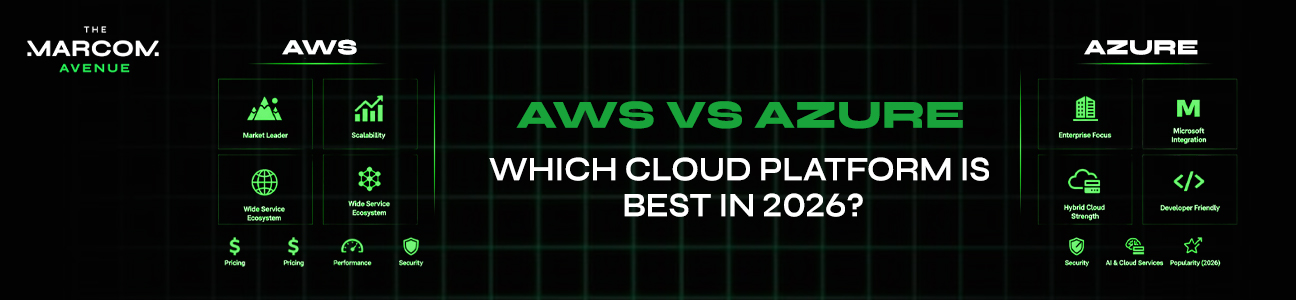
For Indian businesses in 2026, the question isn't about simply adopting the cloud; it’s about picking a strategic partner who really understands the lay of the land here—the unique challenges and sheer scale of opportunity in the Indian market. The intense competition between Amazon Web Services (what is AWS) and Microsoft Azure (what is Azure Cloud) is shaping our nation’s digital infrastructure.
Both have become complete digital ecosystems, which means choosing AWS vs Azure which is better, is now a critical business call. It impacts scalability, cost-efficiency, and, crucially, compliance with government initiatives like Digital India.
In India, this cloud battle has a distinct flavour compared to the global fight.
AWS still holds the edge, especially among the buzzing Indian startup scene, e-commerce giants, and Global In-house Centres (GICs). Their massive scale, extensive depth of services, and a developer-first approach usually make them the instinctive choice for companies chasing agility and breakneck innovation. In fact, one report noted AWS leads in India's cloud project utilisation.
However, Azure is making serious inroads. They've nailed the strategy for large Indian enterprises, bagging major government and BFSI (Banking, Financial Services, and Insurance) contracts. Why? Simple.
Most traditional Indian corporations already run on Microsoft infrastructure—Windows Server, SQL Server, Office 365. For them, Azure is just a seamless, low-friction extension of their current IT; it's practically a no-brainer.
|
Feature |
AWS (Amazon Web Services) |
Azure (Microsoft Azure) |
|
Market Positioning in India |
Frequented by Startups, E-commerce, Tech Services (GICs) |
Dominant in Large Enterprise, BFSI, and Government |
|
Key Local Driver |
Unmatched breadth of PaaS for rapid feature deployment |
Deep integration with existing Microsoft licensed assets |
|
Data Centre Footprint |
Multiple regions (e.g., Mumbai, Hyderabad) |
Expanding rapidly (e.g., Mumbai, Pune, Chennai, Hyderabad) |
|
Best For |
Scaling SaaS, AI/ML-heavy research, DevOps teams |
Compliance-heavy sectors, Hybrid setups, Legacy system migration |

When we compare AWS vs Azure services, both offer robust core features, but their best offerings are designed for different challenges we see here.
AWS: Elastic Compute Cloud (EC2) gives you super-flexible virtual servers. For modern, microservice-based apps (like a payments engine facing massive traffic spikes), AWS Lambda is often the gold standard. It scales instantly from zero to millions of requests—developer Nirvana.
Azure: Azure Virtual Machines (VMs) are the alternative. But here’s the clincher for cost-sensitive Indian enterprises: the Azure Hybrid Benefit. This lets companies reuse their existing Windows Server and SQL Server licenses on Azure. That significantly reduces operational costs, which is a huge deal for firms with legacy Microsoft deployments.
In India, Data Sovereignty and compliance with regulations from bodies like the RBI aren't negotiable.
Security: AWS offers granular control via Identity and Access Management (IAM), preferred by security-first engineering teams. Azure uses Azure Active Directory (Azure AD), which just plugs into existing on-premises Active Directory systems. This simplicity is a major win for large Indian enterprises managing complex, traditional user environments.
Data Residency: Both providers have been busy expanding their local data centre footprints (Regions) to directly address data residency norms, a must-have for any provider of cloud solution services in India.
The AI push is a key driver for India’s next technological leap.
AWS: Their focus remains on SageMaker for building completely custom ML models and Amazon Bedrock for generative AI. This package appeals to specialised data science teams who crave model flexibility.
Azure: They hold a massive, distinct advantage: the Azure OpenAI Service. This gives enterprises secure, compliant access to models like GPT-4, and it often integrates natively with Microsoft tools (think Copilot). This is the shortest, simplest route to enterprise-wide AI adoption for large, often conservative, Indian firms.
Indian firms squeezing margins amid volatile demand can't ignore cloud cost tweaks. Both AWS and Azure run pay-as-you-go, but AWS Savings Plans flex across EC2, Lambda, or Fargate for up to 72% off with 1–3-year commitments.
Azure locks discounts to specific VMs via Reservations, yet Hybrid Benefit stacks up to 80% savings if you're already on Windows/SQL licenses.
AWS Pricing: It's best suited for predictable scale. You can get deep discounts (up to 72% off) through Savings Plans and Reserved Instances—ideal for stable cloud web solutions with consistent traffic.
Azure Pricing: It’s often more economical for Windows and SQL Server workloads, thanks to the Azure Hybrid Benefit. More importantly, for cloud migration services in India involving older systems, being able to repurpose those licenses makes the Total Cost of Ownership (TCO) calculation for Azure incredibly compelling.

Let's be real: a 100% public cloud shift is rare here. Most big organisations prefer a hybrid model, balancing the public cloud’s agility with their data centre’s security.
Azure Arc lets companies run everything—on-site servers, edge gadgets, or even rival clouds—from one easy dashboard in Azure. No need to overhaul old systems; it pulls them all together for smooth oversight. Perfect for firms updating tech while keeping a firm grip on operations.
AWS offers AWS Outposts, which puts AWS hardware right inside the client's data centre. It's powerful, but many see it as less flexible than Azure's vendor-agnostic, software-driven approach to multi-cloud management.
Picking between AWS and Azure boils down to your company's setup and stack. AWS rules for startups, e-commerce giants like Netflix, and anyone needing raw scalability with 200+ services like EC2 or Lambda. Azure shines in enterprises glued to Microsoft tools, hybrid clouds via Azure Arc, or heavy compliance spots like government and finance.
Lean toward AWS if: You're a high-growth startup, an e-commerce player, or a tech-focused company needing maximum service breadth, unparalleled scaling, and deep open-source support. You need the most mature AWS services and Azure services for cutting-edge development.
Consider Azure if: You're running a large operation in India (banking, manufacturing, government sector) that's already built on Microsoft tools. Azure handles hybrid setups well when you need to keep certain data on-premises for compliance. It also connects cleanly with Active Directory if your identity management relies on that.
More companies are splitting their workload now—AWS for the cutting-edge stuff and scale, Azure for enterprise systems and regulatory requirements.
The smartest move, increasingly, is multi-cloud: using AWS for pure innovation and scale, and Azure for enterprise integration and compliance.
Dealing with the complexities of AWS vs Azure demands specialised expertise that genuinely understands the Indian business context. As a trusted provider of comprehensive Cloud Solutions Services in India, The Marcom Avenue helps businesses make the most effective, data-backed decisions.
Whether you require efficient cloud migration services in India to shift your legacy systems or need advanced cloud-based software solutions custom-fit to your business model, our platform-agnostic consultation ensures you choose the right path.
Being a dedicated Website Development Company in India, we make sure your move to modern cloud solution services is technically sound and perfectly aligned with your commercial growth.




I've spent over a decade crafting content that connects. As a Senior Content Strategist at The Marcom Avenue, I dig into culture and demographics to build brand stories that actually resonate. My process: research what audiences care about, then write around those insights. Whether it's analysis or a caption, I focus on earning attention, not just asking for it.


 How to Create an Android App Using AI: 7 Simple Steps Explained
 Custom Software vs Off-the-Shelf: Complete Comparison Guide
 Best Language for Website Development in 2026: PHP, Python, Next.js & More